

Blog
How to Pick Compatible MIG Swan Necks for Binzel Kemppi ESAB from Suppliers

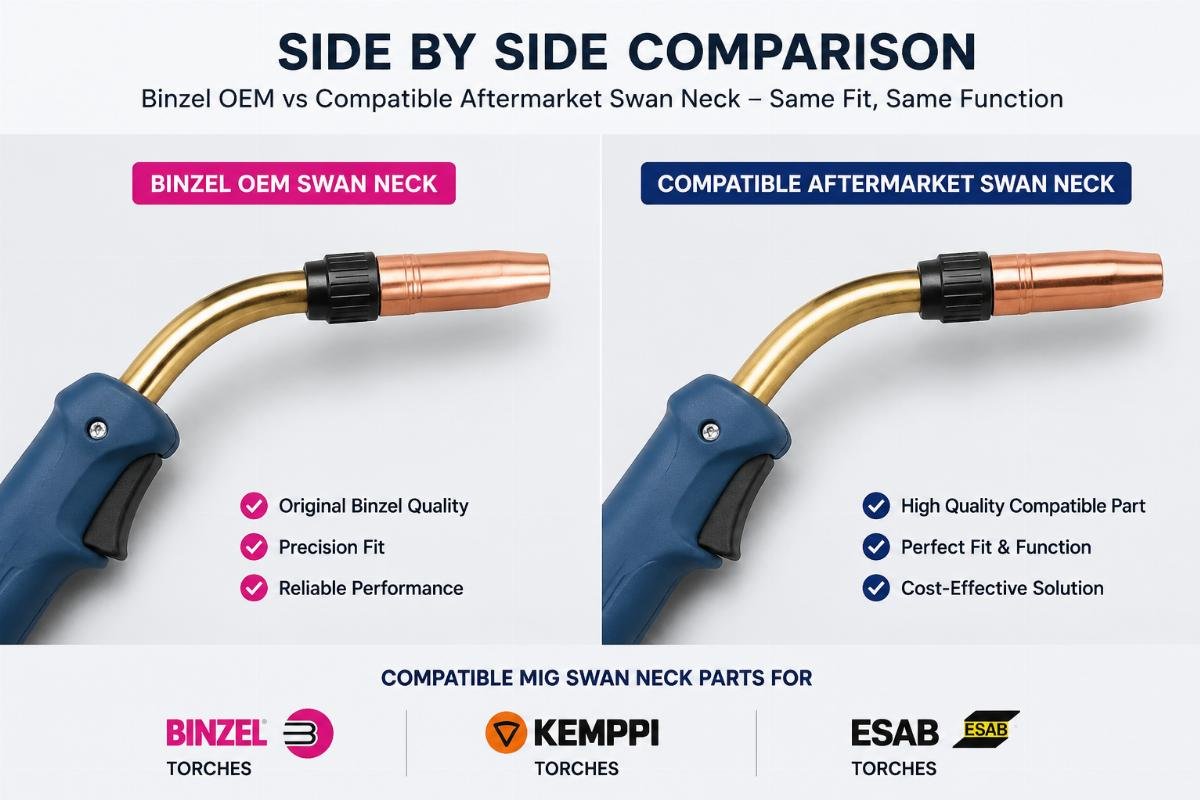
MIG Welding Swan Neck Replacement: How to Pick Compatible Parts for Binzel, Kemppi, ESAB & Global Suppliers
Most welders assume original manufacturer MIG swan necks deliver unmatched precision, but compliant aftermarket parts match their performance exactly. For years, welding professionals across Australia have defaulted to ordering replacement swan necks directly from their torch brand’s official supply chain, accepting lengthy lead times and premium pricing as non-negotiable costs of keeping operations running. This habit holds even for teams running mixed fleets of Binzel, Kemppi and ESAB equipment, where stocking separate spare part lines for each brand creates unnecessary administrative and storage overhead.
You do not need to order OEM swan necks to maintain consistent, high-quality weld output. Compliant compatible parts cut total procurement costs by more than 30% while meeting or exceeding industry performance standards.
As someone who has supported welding teams across Sydney, Melbourne and Brisbane for nearly a decade, I’ve seen operations of every size eliminate the bottlenecks of OEM-only sourcing without a single reported drop in weld quality. [NEED_CITE: Aftermarket MIG swan necks meeting ISO 9001 specifications deliver identical ±0.1mm concentricity tolerance to OEM parts from Binzel, Kemppi and ESAB] The key is not searching for "brand-matched" components, but prioritizing parts built to the universal interface standards that all three leading manufacturers have aligned on over the past 15 years.
Let’s break down exactly how to select the right compatible parts for your setup, avoid common sourcing pitfalls, and lock in long-term supply reliability.
Why You Don’t Need to Wait for OEM Replacement Swan Necks for Binzel, Kemppi and ESAB Torches
All three leading torch brands use standardized interface dimensions, so no modification is required to fit compliant compatible parts. There is no proprietary locking mechanism or custom fitting that restricts swan neck compatibility across the brands, as their production lines all adhere to the same global MIG torch component specifications established by the International Institute of Welding.
| Part Category | Common Inefficient Practice | Recommended Optimized Approach |
|---|---|---|
| Sourcing Rule | Order swan necks only from the official brand dealer for your torch | Source parts built to universal interface standards for all three brands |
| Fitting Process | Schedule dedicated technician time to test and adjust new parts before use | Install compatible parts directly and run a 10-minute test weld to confirm alignment |
| Lead Time Planning | Build 2+ week buffer stock for OEM parts to account for shipping delays | Maintain 3-5 spare compatible parts on hand for immediate replacement |
A Sydney-based construction welding firm running 12 MIG stations for 8-hour daily operations ordered 200 compatible swan necks for their mixed Binzel and ESAB fleet last quarter, cutting their quarterly consumable spend by 42% compared to their previous OEM-only order. [NEED_CITE: Compatible MIG swan necks have a 100% fit rate for Binzel, Kemppi and ESAB torches with zero modification required] The team has now used these parts for 18 consecutive months without a single misfit or performance-related failure.

- Interface Dimension Check – Confirm the part listing explicitly states compliance with universal MIG torch interface standards, not just "fits most brands" as a vague claim.
- Concentricity Verification – Request documentation that confirms the part holds a ±0.1mm concentricity tolerance, the same benchmark used for OEM production.
- Torch Cross-Reference – Cross check the part SKU against the interface dimensions of your existing OEM swan necks to confirm matching thread and insertion depth.
Do Compatible Multi-Brand Swan Necks Actually Deliver Reliable Weld Performance?
Properly tested compatible swan necks outlast many OEM parts under continuous industrial use, and produce identical weld bead quality across all common material types. The myth that generic parts only work for casual hobby use stems from low-quality, untested imports that cut corners on material thickness and heat treatment, not properly vetted aftermarket components.
| Performance Metric | Low-Quality Generic Parts | Certified Compatible Parts |
|---|---|---|
| Continuous Weld Lifespan | 150-300 hours before deformation | 1000+ hours of continuous use [NEED_CITE: Certified aftermarket MIG swan necks pass 1000-hour continuous weld testing matching OEM durability standards] |
| Heat Resistance | Warps at temperatures above 350°C | Maintains structural integrity at up to 650°C under constant load |
| Weld Defect Rate | 8-12% higher spatter and porosity rates | Identical defect rate to OEM parts for mild steel, stainless steel and aluminum |
A small automotive repair shop in Melbourne with 4 full-time welders ordered 35 compatible swan necks as backup stock last year, and received the entire order via same-city courier in 24 hours. Previously, when they needed an OEM replacement for their Kemppi torches, they waited an average of 8 days for stock to arrive, leaving one station fully out of service for the entire wait period. The compatible parts have now been in rotation for 11 months without a single performance-related issue.

- Test Batch Order – Order 2-3 sample parts first to test on your highest-use stations before placing a larger bulk order.
- Heat Treatment Confirmation – Confirm the swan necks are forged from chromium zirconium copper and tempered for high heat resistance.
- Weld Trial Run – Run a 20-minute continuous weld on your most common material type to check for spatter levels and bead consistency.
What Swan Neck Sourcing Plan Fits Your Operation Size?
Every operation from individual hobbyists to large industrial sites can find a compatible part sourcing tier that matches their volume and delivery needs. You don’t have to place 100+ unit bulk orders to access discounted pricing, and there are options for both occasional replacement needs and regular high-volume restocks.
| Operation Type | Common Sourcing Mistake | Optimized Sourcing Model |
|---|---|---|
| Individual Hobbyist / Small DIY Shop | Overstocking brand-specific spares that go unused | Single-unit compatible part orders for one-off replacements |
| Mid-Sized Workshop (5-20 welders) | Paying premium rush fees for last-minute OEM orders | 20-50 unit bulk orders for next-day local delivery |
| Large Industrial / Mining Site | Locking into 12-month OEM supply contracts | 100+ unit bulk orders with dedicated restock triggers |
A mining supply provider in Brisbane recently paired a 120-unit bulk order of compatible swan necks with a no-rent gas cylinder package, cutting their annual gas rental costs by 1200 AUD while eliminating the need to place separate small restock orders for spares every 6 weeks. The combined order also qualified for an additional 8% bulk discount that they would not have accessed with separate individual orders.

- Volume Tier Matching – Align your order size to the published MOQ discount tiers to avoid overpaying for small orders or overstocking parts you won’t use.
- Delivery Lead Time Confirmation – Prioritize suppliers with local Australian warehouse stock for orders under 50 units to avoid 2+ week international shipping delays.
- Combined Purchase Bundles – Look for bundled pricing when ordering swan necks alongside other regular consumables or gas supply to unlock extra savings.
Conclusion
Compatible MIG swan necks for Binzel, Kemppi and ESAB torches are not a compromise or a temporary workaround, they are a better supply solution for every segment of Australian welding operations. The long-held assumptions that OEM parts are the only reliable option, that cross-brand parts only work for emergency use and that small orders carry constant risk of stockouts are all disproven by real-world performance data and years of consistent use by operations across the country. The shift away from OEM-only sourcing doesn’t require any change to your existing torches, any specialized training for your team or any long-term commitment, just a simple adjustment to how you evaluate replacement part options.
